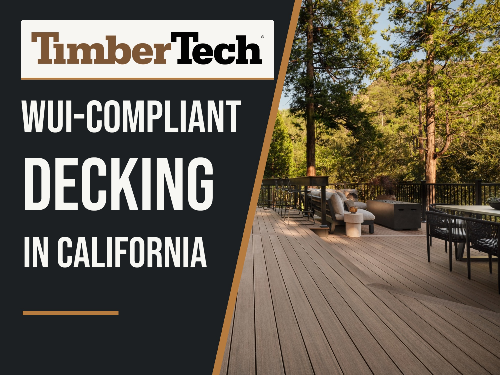
What does WUI mean, and why does it matter for decks?
WUI stands for wildland-urban interface. That’s a long name for places where human development meets wildland vegetation. These areas that may be especially prone to wildfire risk.
WUI compliance means a building material meets set performance rules for wildfire areas. The wildland-urban interface building standards aim to help a building resist flames and burning embers from a vegetation fire. Tests check two things: how easily the material ignites, and how far flames spread across it.
Local building codes in fire-prone states often require WUI-compliant materials. In places like California, these rules are often mandatory.
Do the rules change depending on where you live?
Yes. The idea of WUI compliance is similar everywhere, but the details aren’t. Fire risk, climate, and state codes all shape the rules. Some places focus on the plants around buildings. Others focus on tested materials for decks, fences, and roofs.
Rules can also change inside one state. Cities and counties don’t always follow the same
standards, and some areas near national forests may have stricter rules.
Here’s what to know about WUI Compliance in California:
- Material testing: Decking has to pass testing under the State Fire Marshal’s regulations. That includes how well it resists flame spread and how it withstands ember exposure, which are small burning bits that wind can carry.
- Defensible space: Owners are expected to keep defensible space. That means limiting plants and other things that can burn near the building.
- Changing rules: California keeps updating its requirements, so stay current.
CAL FIRE publishes Fire Hazard Severity Zone maps, and you can type your address in to see how severe a wildfire hazard could be where you live. The maps rate areas as Moderate, High, or Very High. They show how hazardous an area is, not how at risk your own home is. Check with your local building code department or local Fire Marshal for more guidance.
Is WUI-compliant decking enough?
Fire resistance runs on a spectrum, and often WUI compliance is a baseline rather than the peak. Evaluate materials that are WUI compliant as well as carry other fire-resistance classifications.
Two other terms can help you compare products:
- Class A Flame Spread Rating: the best available Flame Spread rating available that measures how quickly flames spread across a surface.
- Ignition Resistant designation: a classification for materials that resist catching fire from direct flame or embers.
Pairing these classifications with WUI compliance may help further harden your deck against fire hazards.
WUI-compliant decking at Golden State Lumber
Ask about TimberTech. TimberTech Vintage and Landmark Collections are Ignition Resistant, Class A Flame Spread rated, and WUI Compliant. Ask your local Golden State Lumber location for availability.
Extreme fire conditions, such as direct flame exposure, sustained high temperatures, or an ignited sub-structure, may still damage or destroy a deck, especially if the substructure beneath isn’t fire-resistant.
TimberTech carries a full-integrated system for hardening your deck against fire.
What building materials should you ask your lumber yard about?
Bring these questions to the counter:
- Which fire designations does this exact collection have? Don’t assume. Ask about the Ignition Resistant designation, the Class A Flame Spread Rating, and WUI compliance one by one.
- What do my local rules require for the rest of the deck? Framing, railing, and other parts may have their own requirements.
- What’s available at my location? Ask what’s on the shelf and what can be ordered.
- Can I see samples? TimberTech offers free samples so you can compare colors and finishes.
What’s the best next step before you buy decking?
First, look up your fire hazard risk. Then bring your permit questions and your deck plan to a local Golden State Lumber location, or send them with a quote request. The team can help you build a materials list. You can also call (855) GSL-YARD. We’ve served Northern California since 1954, and we source TimberTech decking and railing across the region.
*This is general information, not legal or engineering advice. Your local building department or fire marshal has the final word, and code editions change.